
Lead distribution is the process of routing inbound leads to the right field rep at the right moment. For door-to-door and mobile-service teams, the most effective approach combines availability checks, territory-aware routing, and lightweight rule-based criteria, all tied directly to your dispatch workflow.
TL;DR: Three routing methods and what works for field teams
- Round-robin: Assigns leads in rotation. Fair and simple, but ignores travel distance.
- Load balancing: Routes based on each rep's current workload. Better for high-volume teams.
- Rule-based routing: Assigns by territory, skill, or lead type. Most precise, but requires clean data.
- Recommended hybrid: Combine availability windows with territory rules and automated lead routing for the fastest, fairest dispatch.
Automated lead distribution improves speed to lead, reduces manual overhead, and scales with your team without adding administrative work.
Table of Contents
- What lead distribution method fits your field team?
- Why routing quality directly affects field revenue
- How to choose lead-distribution software for field teams
- How to roll out lead distribution in four phases
- Which routing method should you use for your team size?
- Key Takeaways
- What field ops experience actually teaches about routing
- Canvassingme puts real-time routing to work for field teams
- Useful sources
What lead distribution method fits your field team?
Assignment rules can combine all three automated methods and factor in seller availability and capacity. Here is how each one behaves in the field.

Round-robin cycles leads evenly through available reps in sequence. Every rep gets the same number of leads over time, which makes it easy to explain and defend. The drawback for field teams: it does not account for where a rep is standing when the lead comes in.
Load balancing routes each new lead to whoever has the fewest active records. This keeps workloads even across a large team and prevents any one rep from getting buried. It still does not weigh travel time, so a rep with capacity might be 40 minutes from the lead address.
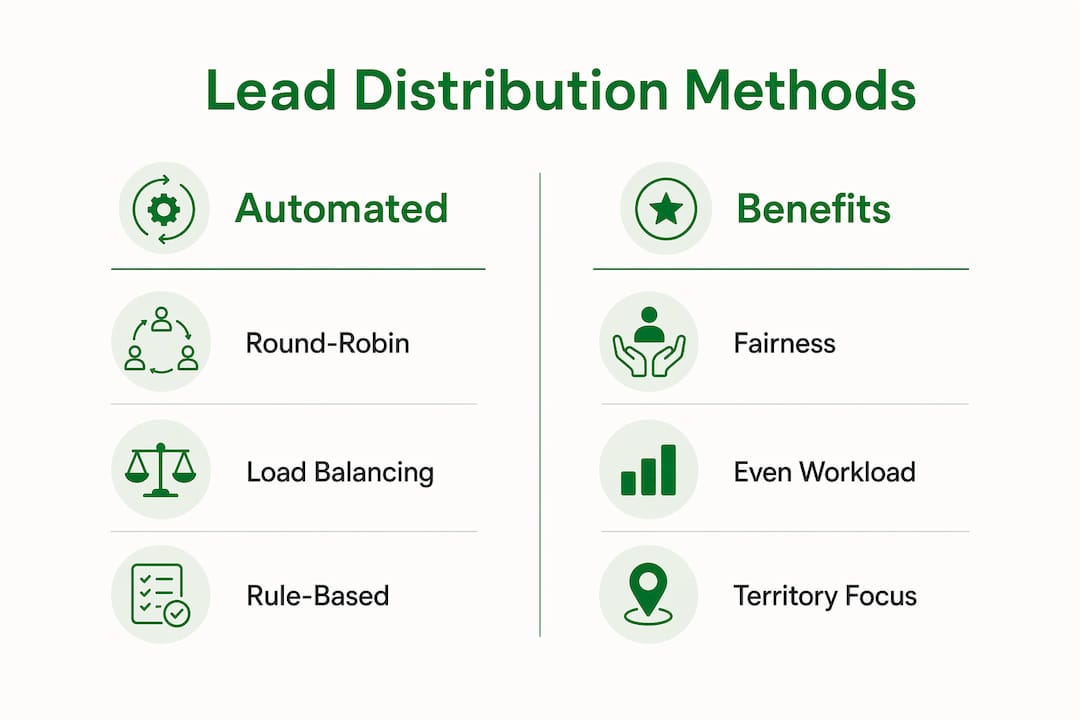
Rule-based routing assigns leads based on defined conditions: territory, zip code, product type, or rep skill. It is the most precise method and the most demanding to maintain. Stale territory data or missing zip codes will cause misroutes.
| Dimension | Round-Robin | Load Balancing | Rule-Based |
|---|---|---|---|
| Travel efficiency | Low | Low | High |
| Fairness perception | High | Medium | Medium |
| Setup complexity | Low | Medium | High |
| Automation readiness | High | High | Requires clean data |
For field teams, no single method covers every gap. Round-robin handles fairness. Rule-based routing handles territory. Load balancing handles capacity. A hybrid that layers all three, gated by availability windows, is the practical answer.
Why routing quality directly affects field revenue
Lead distribution is the execution layer of your go-to-market operation. When it fails, leads stall and revenue momentum breaks down.
For door-to-door and home-service teams, the stakes are concrete:
- A lead assigned to a rep who is 45 minutes away often goes cold before first contact.
- Reps who feel they receive fewer or lower-quality leads disengage, which compounds the problem.
- Missed appointments from poor routing inflate cost-per-close and damage customer experience.
Stat: Speed to lead is a measurable driver of conversion. Prospects who wait longer to hear from a rep are more likely to disengage and move to a competitor.
Transparent routing logic also matters for morale. Even a mathematically balanced system generates complaints if reps cannot see how assignments are made. Visible dashboards and audit trails reduce fairness disputes before they start.
How to choose lead-distribution software for field teams
The right platform for a door-to-door or home-service operation looks different from a standard inside-sales CRM. Prioritize these capabilities:
- Real-time GPS tracking and dispatch integration
- Territory mapping with travel-time-aware routing
- CRM integration (two-way sync, not just export)
- Offline functionality for areas with poor cell coverage
- Appointment scheduling synced to routing decisions
- Transparent assignment dashboards visible to reps
- Role-based access so managers control rules without exposing sensitive data
- Field-focused features like geo-fencing, route recommendations, and mobile lead management
Vendor evaluation questions to ask during demos:
- How does the system handle rep availability? Can you set time-window buckets?
- What is the assignment latency from lead capture to rep notification?
- Can reps and managers see the routing logic in plain language?
- What data hygiene tools are built in for territory and zip-code validation?
- What analytics does the platform provide for response time and assignment success rate?
- How long does onboarding typically take for a team of our size?
- How is pricing structured: per user, per feature, or flat rate?
Red flags to watch for:
- Routing logic that only your vendor can explain
- No audit trail showing which rule triggered each assignment
- No offline or mobile support for reps in the field
- Poor or no integration with your scheduling or calendar tools
- Data clean-up required before launch, with no vendor support to do it
Pro Tip: Keep your routing rules simple enough to explain in one or two sentences. Overly complex logic generates fairness disputes even when the math is correct. Start with three rules maximum and add complexity only after your pilot proves the baseline works.
How to roll out lead distribution in four phases
Start simple, test with a pilot group, and iterate. This approach minimizes disputes and reduces onboarding friction.
- Prep (Week 1–2): Audit territory data, validate zip codes, confirm rep availability calendars, and identify enrichment gaps. Data hygiene at this stage prevents misroutes after launch.
- Pilot (Week 3–4): Choose 4–6 representative reps across different territory types. Run real-world scenarios: test travel times, availability windows, and edge cases like simultaneous lead arrival.
- Iterate (Week 5–6): Measure time-to-first-touch and appointment show rates from the pilot. Adjust territory boundaries, availability buckets, or rule priority based on what the data shows.
- Full rollout (Week 7–8): Train the full team, document every routing rule in plain language, and assign a manager to own rule updates going forward.
KPIs to track from day one:
- Lead response time (target: under 5 minutes for inbound field leads)
- Assignment success rate (lead assigned and accepted by rep)
- Contact and qualification rate
- Close rate by routing method
- Rep acceptance rate (flags reps rejecting assignments)
- Travel miles per appointment (efficiency signal for territory rules)
Data migration checklist before go-live:
- Territory boundaries confirmed and mapped
- Rep availability schedules loaded and tested
- CRM fields mapped to routing rule conditions
- Test scenarios run for edge cases (no available rep, duplicate lead, out-of-territory address)
- Rollback plan documented if routing fails during first week
Canvassingme performance highlights for field teams
Canvassingme reports an average 40% improvement in rep productivity within the first month and a 30% increase in close rates when used to manage field appointments at scale.
The platform features that drive those results map directly to the selection criteria above:
- Real-time GPS tracking for live rep location and dispatch decisions
- AI dispatch assistant for appointment routing and confirmation
- Territory mapping with visual neighborhood-level coverage
- Appointment management for scheduling, tracking, and show-rate monitoring
- CRM integration for two-way data sync
- Offline app support for reps in low-connectivity areas
Canvassingme is built for rapid implementation, with teams reporting operational results within the first month of deployment.
Which routing method should you use for your team size?
Match your team's situation to the method that fits:
- Small canvassing teams (under 10 reps, even territory): Round-robin with an availability guard. Simple to manage, easy to explain, and fair by default.
- Mid-size service teams with high travel variance: Rule-based routing weighted by territory and travel time. Reduces wasted drive time and improves appointment show rates.
- High-volume lead operations (multiple regions): Load balancing combined with specialist routing rules. Prevents rep overload while directing complex leads to the right skill set.
- Multi-region door-to-door operations: A hybrid of all three, gated by availability windows and managed through a live dispatch dashboard. Transparency at this scale is non-negotiable for rep trust.
Whatever the scenario, document the logic and make it visible to your team. Reps who understand how they receive leads perform better and raise fewer disputes.
Key Takeaways
Automated, territory-aware lead distribution with transparent routing rules is the most effective approach for US-based field and door-to-door sales teams.
| Point | Details |
|---|---|
| Start with clean data | Accurate territories and availability schedules are required before enabling any automated routing. |
| Keep rules simple | Routing logic explainable in one or two sentences reduces fairness disputes and rep friction. |
| Measure from day one | Track response time, assignment success rate, and travel miles per appointment from the first pilot week. |
| Match method to team size | Round-robin fits small teams; rule-based routing fits territory-heavy operations; load balancing fits high-volume shops. |
| Canvassingme for field teams | Canvassingme combines GPS dispatch, territory mapping, and AI routing, with reported 40% improvement in rep productivity within the first month and a 30% increase in close rates when used to manage field appointments at scale. |
What field ops experience actually teaches about routing
The conventional wisdom says to automate everything as fast as possible. The smarter move is to automate slowly and transparently. The teams that struggle most after a routing launch are not the ones with the wrong software. They are the ones who built 15 routing conditions before their reps understood the first three.
The fairness problem is real and underappreciated. A rep who cannot see why they received fewer leads than their colleague will assume the system is broken or biased, even when the math is correct. Visible dashboards and plain-language rule documentation solve this faster than any algorithm adjustment.
Data hygiene is the unglamorous prerequisite that determines whether the whole system works. Territory boundaries with stale zip codes, availability calendars that nobody updates, and CRM fields left blank will misroute leads regardless of how sophisticated the routing engine is. Fix the data first. The routing logic is secondary.
Canvassingme puts real-time routing to work for field teams
Field teams that manage appointments at scale need more than a routing rule. They need dispatch, territory visibility, and rep tracking in one place. Canvassingme delivers exactly that: AI-powered dispatch that routes leads by availability and territory in real time, paired with GPS tracking and appointment management built for door-to-door and home-service operations.
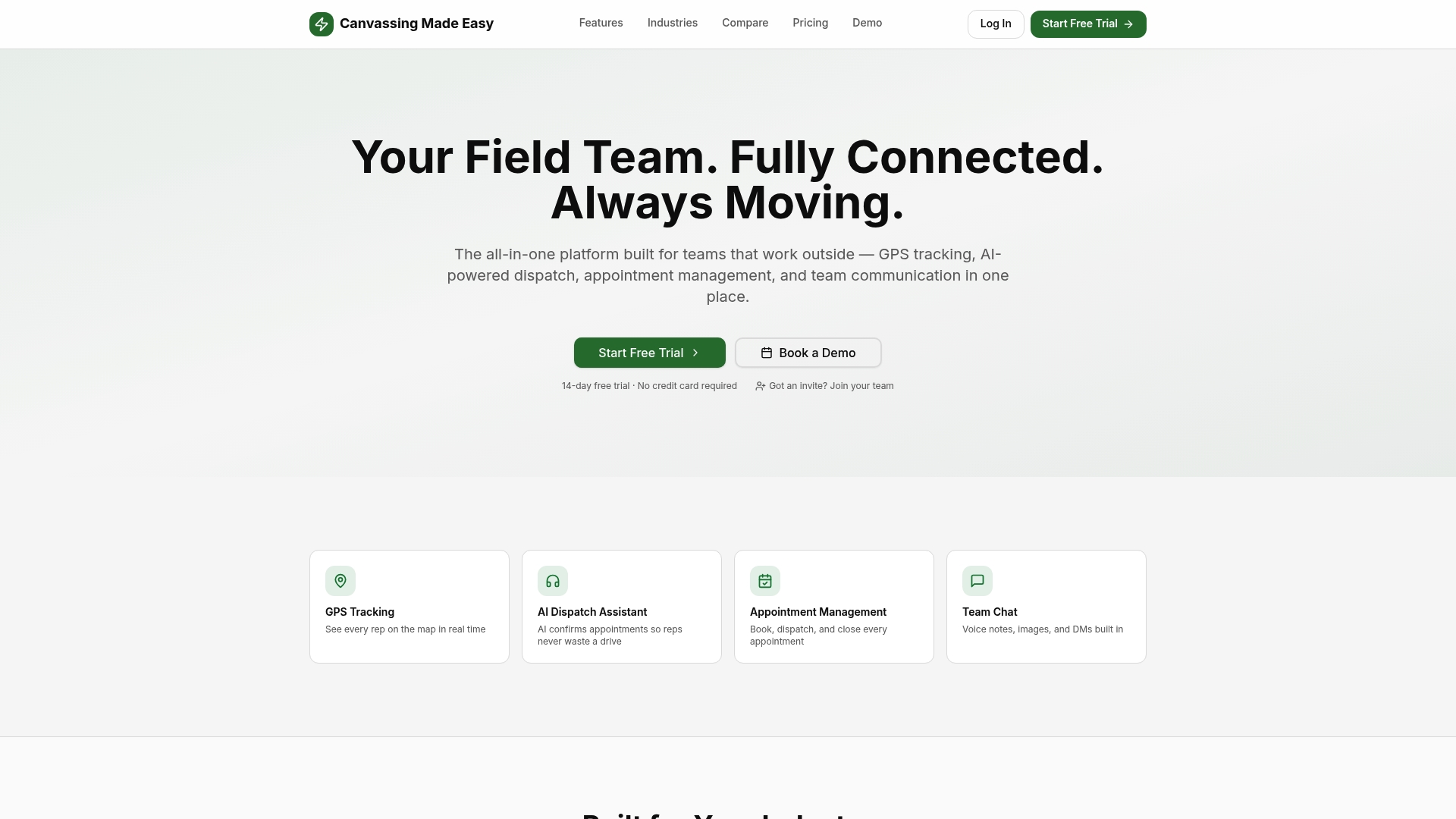
Teams using Canvassingme report an average 40% improvement in rep productivity within the first month and a 30% increase in close rates when used to manage field appointments at scale. The platform covers the full routing workflow: territory mapping, CRM integration, offline support, and transparent dashboards that keep reps informed and managers in control. Schedule a demo to see how the routing setup works for your team size and industry.
Useful sources
- Understand record distribution in assignment rules | Microsoft Learn: Covers how round-robin, load balancing, and availability buckets work in enterprise assignment rule configuration.
- Create and activate assignment rules | Microsoft Learn: Step-by-step guidance on building and activating routing rules, including dynamic attribute conditions and seller capacity calculations.
- What Is Lead Distribution and How Does It Work? | Chili Piper: Explains manual versus automated routing, round-robin mechanics, and the business case for speed to lead.
- Winning the Lead Management Distribution Game | LeanData: Covers distribution as the GTM execution layer, data hygiene requirements, and the fairness paradox in routing transparency.
- Lead distribution | Close blog: Practical guidance on keeping routing rules simple, running pilots, and iterating to reduce disputes.
- Lead Management Software | LeadSquared: Field-focused feature overview including geo-fencing, offline support, and travel route recommendations.
- Future Leads | Canvassing Made Easy: Canvassingme product capabilities and reported performance metrics for field team lead management.